Why Accurate Financials Are the Starting Point for Better Planning
Thought leadership in partnership our friends at Amplify
December is a funny month.
You're wrapping projects, trying to finish strong, buying gifts, and somewhere in the back of your mind you're thinking: I know I need to get ready for next year.
This post is the companion to our recent webinar with Amplify (outsourced CFO) and Good Measure (bookkeeping and finance ops). The goal is simple: help you turn your books into a clear story, and use that story to build a measurable plan for next year

You likely didn't start your company because you love accounting.

But as the CEO, you still have to make the big calls: hiring, pricing, new services, marketing spend, debt payoff, owner comp, growth targets. Those decisions get much easier when your numbers tell the truth and your plan connects to reality.
That's where Amplify and Good Measure work best together. Good Measure handles your financial operations: day-to-day bookkeeping, payroll, bill pay, reconciliations, and clean reporting so your data is reliable and useful. Amplify helps you use that reliable data to model decisions, forecast outcomes, and build a plan you can actually run.
Same mission, different lanes.
Resources from the webinar:
Video Recording: Watch the conversation
Slides + Year-End Planning Worksheet
Financial Foundation Checklist + Visual P&L Example

Clean Books Are the Foundation for Everything Else
Here's the core idea: you can't plan 2026 with messy 2025 inputs. If your data is incomplete, inconsistent, or late, you're guessing. And guessing is expensive.
A healthy financial foundation means:
- Every transaction is reflected in your books
- Nothing that didn't happen is in your books
- You can read your P&L and say, "That matches reality" (see our blog on how to read a P&L)
In the webinar, we walked through a practical cleanup sequence. Here's the short version.
- Gather all your financial sources. Bank accounts, credit cards, payroll platforms, loan statements, POS systems, bill pay tools. Get everything in one place before you do anything else.
- Standardize how you store documents. A consistent folder structure for statements, receipts, and payroll filings makes tax time easier and gives you peace of mind if you're ever audited.
- Choose an honest starting point. When was the last month your books were actually clean? Start there. If you need to go back to January to get an accurate full-year picture, do it. A clean partial year is still guessing.
- Simplify your Chart of Accounts. Your account categories should be simple enough to read and detailed enough to make decisions. If an account has less than $500 in activity per year, consolidate it. No one needs a 20-page P&L if it doesn't drive action.
- Reconcile accounts and clean the balance sheet. Reconciliations prove completeness. If something feels off, that's usually where it's hiding. Make sure your Accounts Payable (what you owe) and Accounts Receivable (what others owe you) are current and accurate.
- Categorize everything meaningfully. "Misc," "ask my accountant," and "uncategorized" aren't permanent homes. Those labels quietly destroy your financial clarity.
If you're a visual learner, the Visual P&L Example we've included in the resources shows where revenue actually comes from, how expenses happen, and which tools create the data trail.
Download the Financial Foundational Checklist
here.
Track the Right Scorecard
Once your books are clean, you can stop staring at a P&L like it's a fortune teller. (Check out our blog on how to read a P&L here)
Instead, you build a rhythm: track weekly activity and performance metrics, identify issues early, and make small corrections before they become big problems.
A scorecard shouldn't feel like busy work. It's your weekly checkup to make sure you're doing the right things in your organization. It connects inputs (activity and operations) to outputs (revenue, margin, cash, capacity).
It also prevents two traps that are more common than people admit: sandbagging goals because you're playing it safe, or throwing out a big number ("200% growth next year!") with no realistic mechanism to get there.
Pair the scorecard with a simple weekly meeting agenda and it becomes actionable. That's where you list issues, assign owners, track initiatives, and spot bottlenecks before they cost you.
Copy the
Scorecard + Meeting Agenda
Understand How Cash Actually Flows Through Your Business
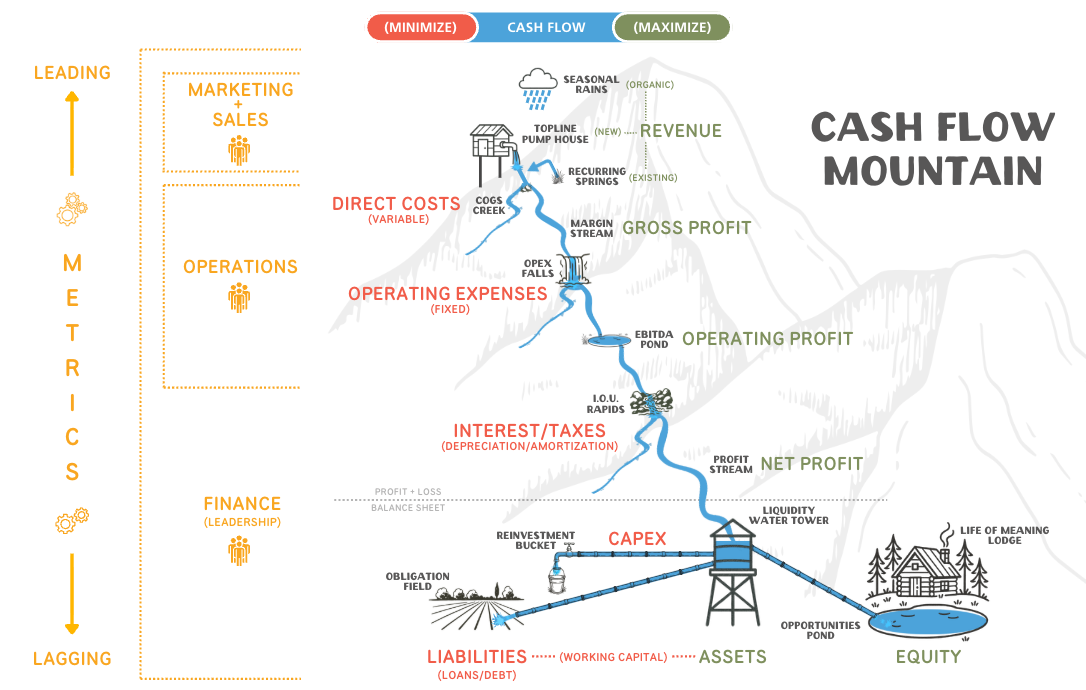
Even when revenue looks strong, you can still feel squeezed. That's because top-line revenue isn't the goal. The goal is available resources: the extra cash left after the business runs.
The Cash Flow Mountain is a visual model Amplify introduced in the webinar that shows how dollars actually move through a business, from revenue sources all the way down to what's left for real choices: investing, hiring, paying down debt, saving, and building a life you actually want.
Understanding this model changes how you think about growth. It's not always about making more. It's about keeping more of what you make.
Download the Cash Flow Mountain Framework
Plan with the End in Mind
Your plan should start qualitative, then become quantitative.
Because the real question isn't "How do I grow?" It's "What am I actually building this business for?"
That's why the Year-End Planning Worksheet begins with questions like: What do I want next year to look like, personally and professionally? What needs to change for that to become real? What decisions around hiring, pricing, and focus will get me there?
Then you work backwards into the numbers: what actually happened in 2025, what needs to change in 2026, what your break-even reality is, and what must improve across margin, utilization, pricing, collections, or overhead.
A good forecast isn't fortune-telling. It's a model of how your business works. When you change one input (pricing, a new hire, a marketing investment), you should be able to see how it ripples through everything else.
That's what Amplify calls MAP: Measure what actually happened versus what you expected. Adjust your assumptions and actions. Predict what that means for the rest of the year. That's how you stop reacting and start steering.
How Amplify and Good Measure Fit Together
If you're trying to figure out what kind of help you need, here's the clearest way to think about it.
You want Good Measure when you need clean, reliable books you can trust. Consistent monthly closes and reconciliations. Payroll, bill pay, and invoicing handled well. Reporting that actually makes sense to a business owner. A capable team that feels like part of your team. Good Measure's promise is confidence: clear, accurate, dependable execution on your day-to-day financial operations.
You want Amplify when you need a forecast connected to reality. Scenario planning for decisions like hiring, raising prices, adding a service, or investing in marketing. Targets that roll down into weekly execution. Decision support so you stop guessing at the biggest moves.
Different roles, same outcome: a business that supports a life of meaning, with numbers that serve the vision.

By • February 19, 2026
Custom Estimate
From bookkeeping and payroll to processes, reporting, and financial interpretation, we connect every part of your financial system so you always have accurate data and clear direction.
SHARE THIS
Latest Posts